
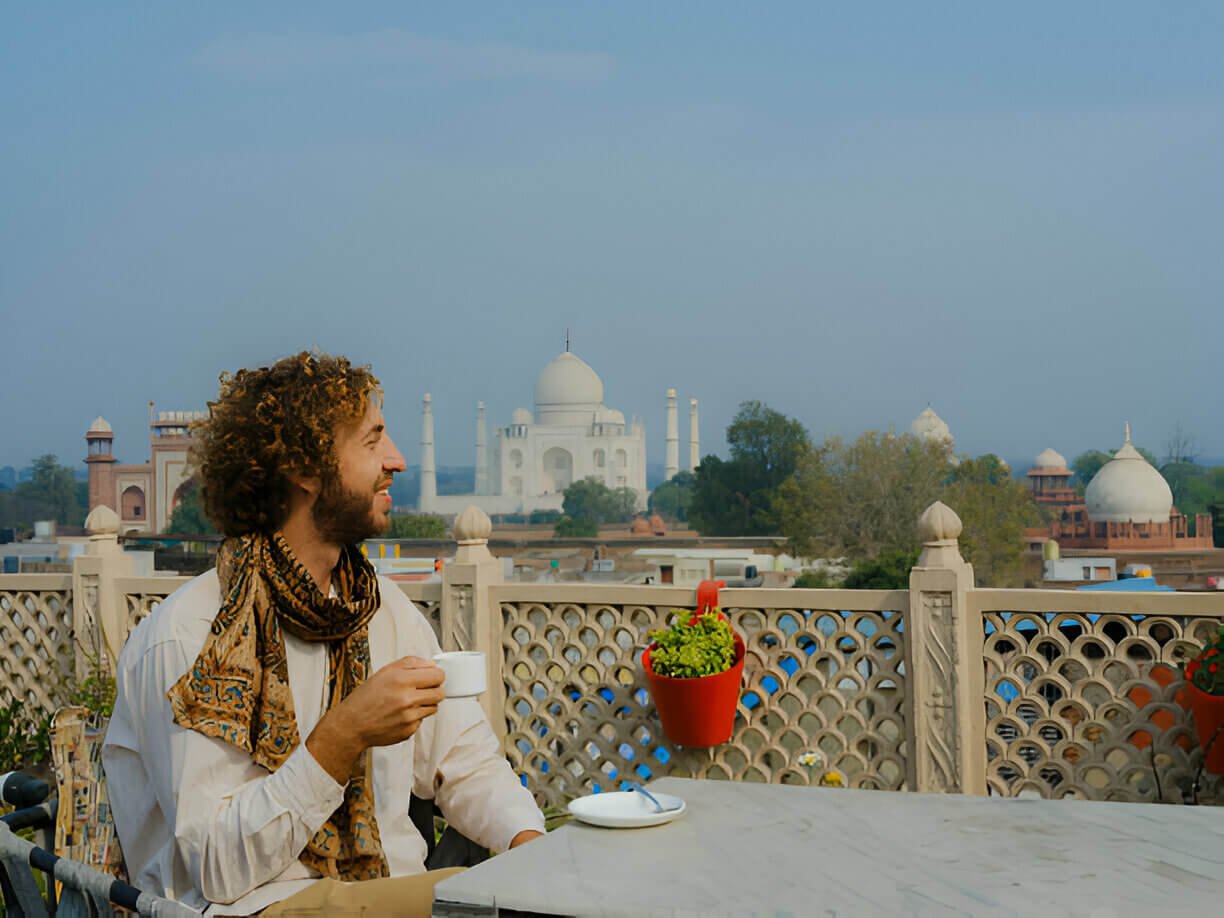
It won’t be an exaggeration to say that the Taj Mahal is one of the most admired architectural gems of the world. The gigantic monument exemplifies excellent architecture, planning and management, and intricate craftsmanship.
The tales of its construction and the use of precious and semi precious stones in the walls of the monument says a lot about fondness of decoration and arts in the bygone era.
There is more to this and it’s all covered in this blog for you. Give it a read and shape your Taj Mahal tour perfectly.
Historical Background
Shah Jahan & Mumtaz Mahal

The story of the Taj Mahal begins with the Mughal Emperor Shah Jahan and his beloved Empress Mumtaz getting married in 1612. She was beautiful and was the favourite wife of the King. Their intimacy, affection, and admiration for each other were special and popular.
Things changed in 1631 when the Empress died while delivering a baby. The news shook the Emperor. He was devastated by the thought and the pain of separation was unbearable.
Her demise hit him so hard that he gave up worldly pleasures and luxury lifestyle and started living a modest life.
He only wore White and didn’t wore floral clothes, neither applied perfumes, nor did he trimmed his beard. He was shattered from inside and there was nothing that could console him.
Construction and commissioning by Emperor Shah Jahan
Construction of tombs, mausoleums, and funerary gardens for the memorable was a strong tradition and ritual in the Mughal Dynasty.
Hence, the mausoleum of Mumtaz Mahal was to be erected and it had to be magnificent because of the fact, that it was of the Imperial Empress.
The architects were called upon and were tasked with creating plans of a grand mausoleum that would be a replication of the real-world paradise. The Emperor was himself the chief supervisor above all architects, designers, and artisans.
May the tomb of Mumtaz Mahal be a paradise – Bibadal Khan (Poet of Mughal Court).
The quote itself reflects how magnificent the monument was planned to be. It had to look nothing less than a paradise.
Arts and architectural works during the Mughal Empire were a way of expression of the rulers. Shah Jahan was amongst the top Emperors in whose reign arts and architectures prospered the most.
Shah Jahan wanted the mausoleum to look like a paradise with naturalist elements. He wanted it to be the most beautiful monument the world has ever seen.
Architectural Marvel
After the demise of the Empress, the architects were brought in the court from different regions. Multiple plans and architectural designs were presented before Shah Jahan. Designs were laid out and it was time to execute them and turn the dream into a reality.
The site was finalised and the construction began. On every death anniversary (Urs) of Mumtaz Mahal, there was a small celebration at the site of the Taj Mahal. It took more than 20 years to complete the Taj Mahal.
The architectural style of the Taj Mahal is Mughal Architecture. However, one can see that it is also a fusion of Persian, Hinduism, Islamic and Cristian architecture. The monument is made with one of the purest white marble on the planet – the Makrana White Marble. This marble has less than 1% corrosive properties, making it the top choice for the construction of the monument.
The marble was sourced from Makrana, some 400 kilometers away from present Agra city. It is believed that over 10,000 tons of Makrana white marble was carted with bullock carts, elephants, and oxens. There is also the use of Red sandstone in the construction of the entry gates of the Taj Mahal along with other buildings of the Taj Mahal complex.
Visiting the Taj Mahal
Experiencing the beauty of the Taj Mahal in person is an extravagant experience. For a connoisseur of fine arts and history, the experience gets more elevated as the monument is itself a piece of art and you’ll fall in love with it as you visit it.
For planning your Taj Mahal tour, October to March is the best time. The mornings are cold and pleasant and the daytime is soothing and warm. January is a bit cold as it is the peak winter month but the rest of the days; you’ll have a good time here.
Entrance Fee and ticket info
- Taj Mahal remains closed on all Fridays. Monday to Thursday is suitable as there are fewer crowds than Saturday and Sunday.
- To visit the main mausoleum, one has to buy an additional ticket of Rs. 200 along with the standard ticket.
- Foreigner/NRI ticket price: Rs.1100
- Indian ticket price: Rs.50
- SAARC/BIMSTEC: Rs. 540
How to reach Agra to see the Taj Mahal
The city of Agra is around 230km from Delhi airport and is well connected through roads and railways. Both cities are connected well via the Yamuna Expressway and National Highway. You can choose either of them to visit the city. As of now, there is no International Airport in Agra despite being such a popular tourist destination.
The reason stated is that Agra city has an Air Force station that is strategic and critical for safety reasons. Hence, an International Airport in the city is unlikely. Though there is a new International Airport in construction in Jewar, a planned city between Delhi and Agra.
You can also travel to Agra by Indian Railways. Gatimaan Express and Bhopal Shatabdi Express are two trains from Delhi to Agra Cantt. The
Accommodation
On your Agra tour, you will have some of the most opulent and finest hotels on the list. You’ll be amused to know that some of Agra’s premium 5-star hotels are rated amongst the best and most luxurious hotels in the world. So are you ready to dip into an extravagant luxury affair?
Along with the most premium ones, there is also a range of other pocket-friendly options that offer comfortable stays without breaking an arm or a leg.
Exploring the Taj Mahal
The Taj Mahal is a beacon of architectural beauty that attracts admirers of beauty from all around the world. When you are in the Taj Mahal complex, you will be awestruck to see how picturesque the monument is.
It is advised to visit the Taj Mahal during the dawn. The first of the sunrays turns the white translucent marble into hues of yellow and gold and the Taj Mahal looks spectacular and extraordinary than the rest of the day. You will get the most momentous pictures during the dawn time and your early waking up will be all worth it.
Secondly, you might be lucky enough to capture the Taj Mahal without any crowd (just the Taj Mahal and you) if you are amongst the first ones to visit the monument.
Etiquettes and guidelines
Just like any other tourist place, the Taj Mahal can get a little crowded at times. Follow the queue whenever there is any! Beware of unidentified tour guides, drivers, and scamsters. It is advisable to book a tour with a registered travel agency for a comfortable experience.
For photography and recording purposes, you can take in mobile phones, and professional cameras. However, you cannot take Tripods, microphones, or drones inside the Taj Mahal complex. The Taj Mahal is in proximity to the Army Cantonment, hence, drones are a big NO!
Get Taj Mahal handicrafts and souvenirs
You can shop for exquisite marble handicrafts and Mughal carpets. Both of these handicraft types have their heritage coming from the artisans who actually built the Taj Mahal. Hence, these are unique and can be shopped as souvenirs.